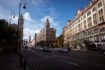

The Jewish Quarter — Budapest’s most vibrant central neighbourhood.
Quick Facts
| Location | Central Pest, east of District VI |
| Character | Historic Jewish Quarter, nightlife, ruin bars, cafés |
| Price range | €3,200–€5,000 per m² |
| Population | ~55,000 residents |
| Best for | Young professionals, rental investors, buyers wanting central buzz |
What Makes District VII Distinctive
District VII — Erzsébetváros, but universally known as the Jewish Quarter — is Budapest’s most internationally recognised neighbourhood. Its dense fabric of courtyards, passage buildings, and interconnected streets hosts the famous ruin bars (romkocsmák), independent galleries, third-wave coffee shops, and a rental market that has anchored Budapest’s short-term stay economy for over a decade.
The district is compact and intensely walkable. Historic synagogues sit alongside street art, kosher restaurants alongside natural wine bars, century-old bakeries alongside speciality coffee roasters. It’s a neighbourhood in constant motion.
District VII attracts a different buyer profile than District V or II. Its density and nightlife make it less family-friendly, but for young professionals, investors, and buyers who want to be at the centre of Budapest’s cultural life, nowhere else in the city offers this concentration of character.
Who District VII Suits
A great fit for:
- Young professionals and creatives
- Rental investors targeting mid- and long-term expat tenants
- Buyers who prioritise cultural life and walkability
- Second-home buyers wanting a central pied-à-terre
- Buyers seeking better value than districts V or VI while staying central
Less ideal for:
- Families with young children (density, nightlife noise, limited green space)
- Light sleepers (some streets have all-night activity)
- Buyers relying on Airbnb income (regulations have tightened significantly)
- Buyers seeking peace and quiet
Amenities and Daily Life
Shopping and dining:
Restaurant and café density is among the highest in Budapest. Kazinczy Street, Király Street, and Dob Street form the culinary and social heart of the district. Independent boutiques rather than chain stores dominate. Weekly farmers’ markets (Szimpla Kert Sunday market being the best-known) provide regular fresh produce.
Schools:
Limited residential schools within the district. International school families typically choose Buda districts (I, II, XII). Local Hungarian schools of good quality exist for local families. A handful of specialty Jewish schools operate in the historic quarter.
Healthcare:
Multiple private clinics and specialist practices. Central Budapest hospitals are within 10 minutes. English-speaking care is broadly available.
Green space:
Limited within the district — this is dense urban living. City Park (Városliget) is a 10-minute tram ride away. Erzsébet Square (small) sits at the district’s western edge.
Cultural attractions:
The Dohány Street Synagogue (largest in Europe), Jewish Museum, and multiple historic sites anchor the district’s Jewish heritage. Ruin bars — Szimpla Kert being the original — have become iconic Budapest attractions.
Transport
Metro:
- M1 (yellow line) — Deák Ferenc tér and Opera stations at the district’s western edge
- M2 (red line) — Astoria and Deák Ferenc tér stations
- M3 (blue line) — Deák Ferenc tér
Deák Ferenc tér is at the district’s western boundary — the intersection of all three metro lines, making District VII exceptionally well-connected.
Tram:
Trams 4 and 6 (Budapest’s busiest) run along Erzsébet körút, the district’s northern boundary — 24-hour service, connecting to virtually every other central district.
Airport:
Budapest Ferenc Liszt Airport is 30–40 minutes by taxi. Direct 100E airport bus stops at Deák Ferenc tér.
International trains:
Keleti (Eastern) railway station is a 10-minute walk or 5-minute tram ride, offering direct connections to Vienna, Munich, and other European destinations.
Driving and parking:
Driving is challenging — narrow streets, one-way systems, heavy pedestrian and tourist traffic. Street parking is heavily metered and highly competitive. Garage parking is scarce and expensive when available.
Neighbouring Districts
District V (Lipótváros) — directly west, historic prestige district with government buildings. Roughly 40% more expensive per m² than District VII.
District VI (Terézváros) — directly north, Andrássy Avenue and cultural life. Similar character to District VII but slightly less dense, slightly more expensive.
District VIII (Józsefváros) — directly south, mixed character with recently gentrifying areas around the Corvin Quarter. Meaningfully cheaper than District VII.
District IX (Ferencváros) — southwest, redeveloped areas along the Danube. Growing quickly in appeal to young professionals.
Price and Market Snapshot
Renovated apartments in District VII typically trade between €3,200 and €5,000 per m², with prime central pockets pushing higher. A well-renovated 60m² apartment in a good building runs approximately €200,000–€300,000.
The district has seen substantial price appreciation over the past decade, driven by tourism, expat demand, and international investor interest. New renovations continue to convert older courtyard buildings into modern apartments.
Rental yields are among the highest in central Budapest — typically 4.5–6% gross for long-term rentals — reflecting strong tenant demand from young professionals and mid-term expat stays.
What to Know Before Buying
- Short-term rental (Airbnb) regulations have tightened significantly. District VII was among the most heavily affected by 2024–2026 municipal restrictions. Do not build an investment case around Airbnb income without verifying current rules.
- Noise varies dramatically by street. Kazinczy Street, Dob Street, and other nightlife-heavy streets can be loud at night. Quieter streets exist within blocks — location matters.
- Building quality varies widely. Some period buildings are beautifully renovated; others need significant work. Always inspect the building common areas, not just the apartment.
- Building common charges (közös költség) vary — historic buildings with elevators and courtyards often have higher maintenance costs.
- Parking is a serious challenge. If you own a car, factor in garage costs (€25,000+ to buy, or €150–250/month to rent).
Related Reading
- The Budapest District Guide for Property Buyers
- Renting vs Buying in Budapest — What Expats Need to Know
- How Foreign Buyers Get a Mortgage in Budapest — 2026 Guide
Sources & Methodology (click to expand)
Prices, transport information, and district character in this guide are sourced from published 2026 data and cross-referenced across multiple industry references.
Price data: KSH (Hungarian Central Statistical Office), ingatlan.com, MNB Housing Market Report May 2026, Housiko Budapest apartment prices index June 2026, Investropa Housing Prices 2026, Duna House and Otthon Centrum published analyses.
Transport information: BKK (Budapest Transport Centre) official metro, tram, and bus maps.
Short-term rental regulations: Budapest municipal decrees 2024–2026 on District VII short-term rental licensing restrictions.
District demographics: KSH district-level data, Budapest Municipal Government open data portal.
Disclaimer: All figures reflect mid-2026 market conditions and are indicative price ranges, not guaranteed prices. Short-term rental regulations continue to evolve. Always verify current pricing and rules with a licensed real estate professional before purchase decisions. This is general market orientation, not investment advice.